Alfie Dennen

Saisakul Chernbumroong

When the Incubator for AI (I.AI) team retired their Redbox codebase in December 2025, DBT had already diverged substantially from that original work. What began as collaboration evolved into something distinct, shaped by 2 years of iterating with users and the specific needs of civil servants working with Official Sensitive material.
Rebranding when technical divergence requires new identity
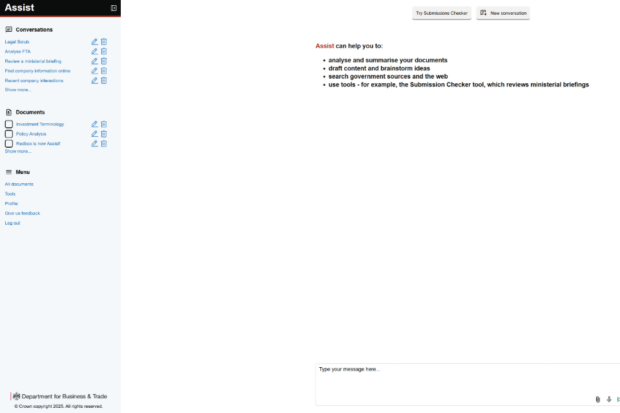
Redbox at DBT is now called DBT Assist. The rebrand to DBT Assist isn't cosmetic. Redbox carried I.AI's identity: their naming conventions, design system(s), and roadmap. As we diverged technically, building new capabilities and patterns for handling sensitive information, the branding became misleading. Users expected the central government product, but we were building something fundamentally different.
DBT Assist signals what the tool actually does: it assists with specific, high-value tasks where generic AI falls short. Rather than a general-purpose chatbot, DBT Assist provides specialised capabilities for repeatable workflows from quality-checking ministerial submissions to extracting company intelligence from internal databases.
The design challenge
Many of us use consumer AI services like ChatGPT in our personal lives. When we use Large Language Model (LLM) tools at work, we expect conversational interfaces, immediate responses, and familiar interaction patterns. But the Government Digital Service (GDS) design system wasn't built for streaming AI responses or dynamic chat interfaces.
The challenge was balancing modern expectations against institutional trust requirements. When someone uploads an Official Sensitive document, they need confidence it's handled appropriately. When they use an AI-generated summary in a ministerial submission, their name is on it. The interface must communicate both capability and accountability.
We created new patterns such as chat interfaces, streaming responses, and source citations with page-level precision. We did this while preserving the familiar GDS and departmental branding. The result feels immediate and conversational while maintaining essential trust markers.
Contributing design patterns for cross-government use
This work can be contributed back to GDS and other departments. We're not alone in this territory. Across government, teams are building conversational AI including:
- GDS with GOV.UK Chat
- DVLA with customer service chatbots
- DBT’s own Business Growth Services chat beta
- FCDO with correspondence triage
The pattern is consistent: start with summarisation and search, scope tightly, measure rigorously, and build trust before expanding. By documenting our approach including the components we built, the user research that informed them, and the patterns for sensitive information, we can accelerate implementation for other departments facing the same challenges.
Trust as a functional requirement
In consumer AI, trust is assumed. In government, it must be earned continuously. Trust isn't just security controls. It is a result of:
- interface design that communicates provenance
- citations linking to source documents
- clear labelling of AI-generated content
- transparent handling of sensitive information
Our approach is carefully measured, ensuring we understand whether technological advancements genuinely translate into increased productivity. This extends to the interface itself. Users need to see where information comes from, understand limitations, and maintain agency over how they use AI-generated insights.
Building on proven foundations
Back in 2024, through joint workshops, employee secondment, and code-sharing with I.AI, we got Redbox running in one month. That foundation enabled rapid iteration based on user feedback.
Since then, we learned which capabilities matter most. A Policy Advisor told us the Submissions Checker was "impressive" in how it "challenges the clarity of argument and evidence bases," acting as "an independent pair of eyes". It helps "avoid documents being returned for corrections, ultimately saving valuable time." These insights drove our evolution toward task-specific tools.
From generic chat to purpose-built tools
DBT Assist now features an improved interface built around what we are calling ‘Tools’. Instead of a blank chat, users choose from purpose-built capabilities for specific workflows like Submissions Checker for quality assurance and InvestLens for company intelligence. We are currently working on a Negotiation Planner for trade precedents.
This reflects a broader insight. The most valuable government AI applications aren't the most general ones. They are tools that understand specific professional contexts, integrate with departmental systems, and augment rather than replace human expertise.
A replicable pattern
The path from Redbox to DBT Assist demonstrates a pattern for government AI adoption:
- Start with open-source collaboration to avoid duplication.
- Engage users continuously to understand actual needs.
- Build trust through transparency in architecture and interface.
- Create new design patterns where existing ones don't serve conversational AI.
- Measure carefully before claiming efficiency gains.
- Scope tightly to high-value use cases.
- Contribute back to accelerate cross-government adoption.
We publish our code openly and regularly collaborate with other departments. As government explores generative AI, the approach matters more than technical choices. It builds trust through transparency, creates reusable patterns, and focuses on problems where AI demonstrably adds value.
DBT Assist represents DBT's contribution to this collective learning. Our platform is built through collaboration, refined through user research, and designed to assist with the complex, sensitive work of modern government.
Innovation, collaboration and trust must go hand in hand in government. If your team is exploring what is possible with AI tools, we want to hear from you in the comments.
This post was previously published using the term “Assist”. We have updated it to “DBT Assist” to avoid confusion with similarly named tools used elsewhere in government, including GCS Assist and Survey Assist. Each tool serves different user groups and use‑cases, and this update ensures the distinction is clear to all readers.