Andy Revell

I am a Product Manager in the Employee Experience team at the Department for Business and Trade (DBT). My portfolio helps DBT colleagues to work efficiently, be productive and stay connected by improving the tools they use every day.
Like most large organisations, DBT holds a lot of information. Policies, guidance, ‘how do I’ pages, process notes and updates all live on the intranet. Over time, that information grows and changes. There is a constant user need to easily find clear answers to work problems, so users can get on with their job.
A shared problem: finding answers from a large volume of information
Our department and colleagues are distributed across the UK and around the world. Trying to find the right person, the specialist team and the relevant information takes time. People search the intranet, click through several pages, or ask teams questions that have already been answered elsewhere. Support teams told us they get the same queries repeatedly. Individually, each question is small but collectively, it adds friction to everyday work.
Efficiently querying large volumes of information is a common challenge in complex organisations. It’s not usually down to a lack of effort or expertise. It’s about scale. As content grows, it becomes harder to know where to look, or whether what you’ve found is even relevant.
This felt like an area where we could unlock value from AI in a practical way, by using technology to solve a user pain point that almost everyone in DBT has grappled with at some point, regardless of their location, role or experience.
Our vision
Our goal with Ask DBT was simple to describe, but less easy to deliver.
We wanted to give colleagues a way to ask questions in plain English and get clear, trusted answers drawn entirely from intranet content. The sort of questions our analysis told us people were already asking, just without having to know where the answer might live.
There were constraints from the start. To encourage people to use AI to answer questions, you must build trust in the tool. People need confidence that answers are sensible, with clear and transparent sources. Out-of-the-box tools exist, but they bring licensing costs and are harder to tailor to a specific organisational context.
We also needed to be realistic about what we were trying to achieve. For us, that meant saving time and helping people feel confident they were acting on the right information. We were not trying to achieve perfection, and not replacing human judgement either.
Our collaborative approach
Recognising that this was both a technical and a content challenge, we needed to work across teams. To develop the solution, we brought together colleagues from our AI Lab, AI Factory and Employee Experience teams.
As Lead Developer, Marcel Kornblum puts it:
“This project brought together a combination of teams and expertise that hadn’t combined before at DBT, with Data Scientists and Service Engineers needing to work out how to use their expertise together.
Not everything went smoothly; both sets of people had hard requirements and areas of functionality they didn't understand very well. Figuring out how to communicate with each other and how to meet each other’s needs took time. We had to align expectations, language, constraints and pace while communicating across the wider project team and the organisation.
Building that trust and respect was a great learning experience for all of us, and a theme we took throughout the build and into the product itself. Ask DBT surfaces source material alongside its answers, helping build both accountability and confidence in the responses.”
Introducing Ask DBT
The result is an in‑house AI‑powered tool designed to query intranet information in a user‑friendly way. Many people are now used to chat‑style tools in their everyday lives. Asking a question and getting a response is rapidly feeling more natural than navigating through a search box and multiple pages.
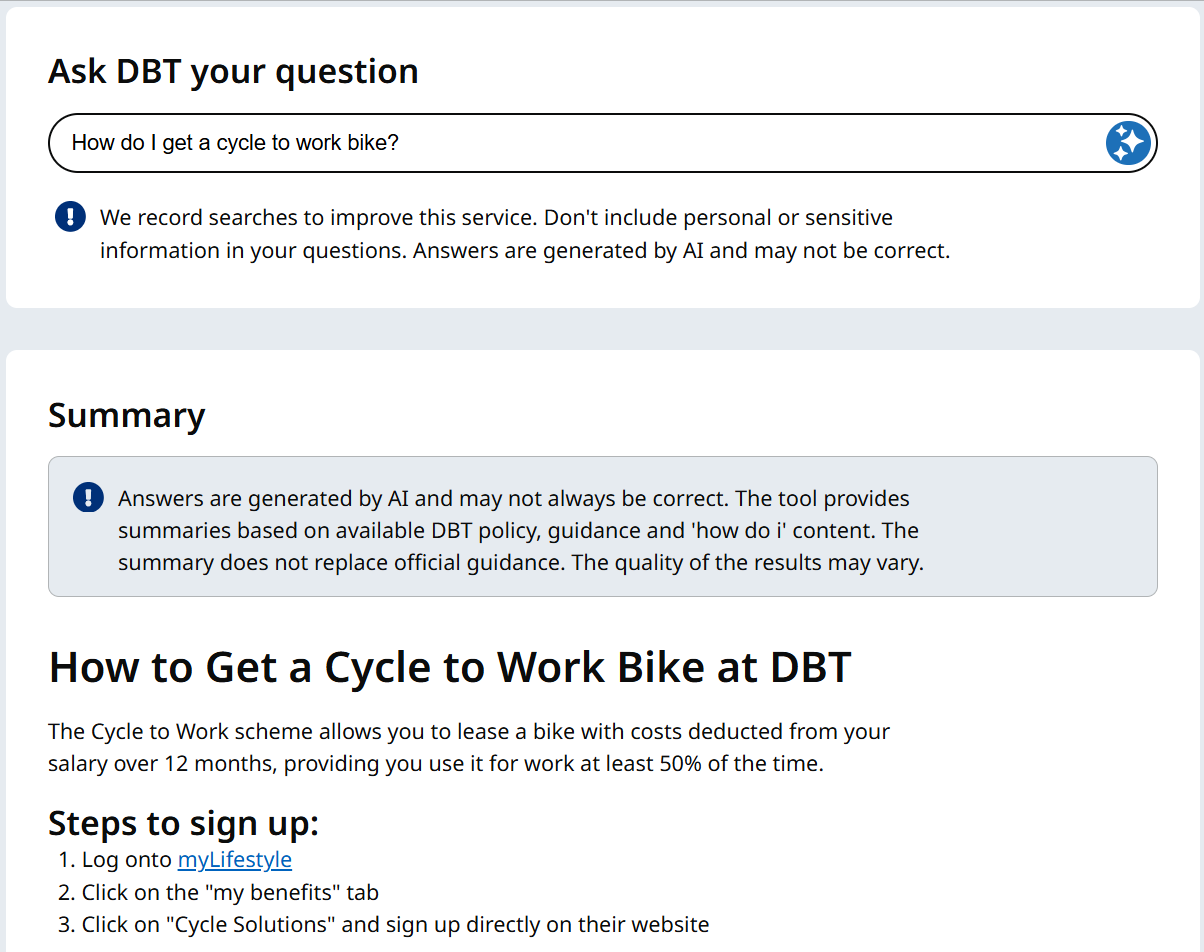
Under the hood, the tool uses a Large Language Model. Put simply, that’s a system trained to recognise patterns in language so it can generate responses. The important point for users isn’t the technology itself, but that answers link back to trusted sources so people can see where information comes from.
We knew we wouldn’t get it right first time. That’s where Agile ways of working helped. Agile just means building in small steps, learning from feedback, and adjusting as you go. We released early versions, listened carefully to user feedback, and iterated.
What impact we've seen so far
Over 30% of the trial cohort used Ask DBT. It has already shown clear potential to free up time answering routine questions about IT kit, travel and expenses. 61% of queries were answered immediately. If further information is needed, the tool shares useful source material where it can be found.
There’s an appetite for tools that enable productivity and reduce operational friction. As an in‑house tool, it’s open for all colleagues to use, and we can gather feedback directly and see where it helps and where it doesn’t. Those feedback loops are valuable for iterating the product.
During testing and piloting, colleagues told us that the tool helped them get answers more quickly and reduced the need to reach out with questions.
Several people said it saved them time answering routine questions, which meant they could focus on more valuable work instead.
We’re learning about the questions people actually ask, which in turn highlights where intranet content could be clearer.
What we learned along the way
One key lesson was the importance of bringing people along the Agile and iterative journey. We needed to make sure that we had significant engagement and adoption of Ask DBT to ensure that the tool met people’s needs. We’re continuing this approach via live demos at team meetings and requests to try the tool out and share feedback, good or bad.
Some users expect new tools to be finished from day one. We had to be clear that early versions were to be tested by users. Our message was that feedback was the way to shape the product, not judge it.
We also learned to treat setbacks as information. A poor answer from Ask DBT isn’t a failure, it’s a way to learn and improve the tool and the content.
These lessons aren’t unique to AI. Any team building new tools in government faces similar challenges around collaboration and iteration.
What's next
Ask DBT is evolving. It’s part of a wider shift in how we think about developing and managing digital tools. AI may not be the answer to everything, but it can become part of the everyday tools we use to reduce friction at work.
We’re continuing to learn what it takes to develop this new technology responsibly, how we improve over time and when to pause, reflect and shift direction. That rhythm feels closer to our new normal than a linear rollout.
As we built Ask DBT in-house, we reap the benefits of all the resources we put into developing and improving it. It’s our own tool, built by us, for us. With no licensing costs, control over how and when it is updated, and closeness to the tool’s users, we are well placed to improve it as user needs change and apply what we’ve learned to other digital products.
A final thought
For me, using AI well in government is about understanding the problem to be solved and how AI might be a solution. It is about aligning user trust with experimentation, and rapid delivery with learning.
If you’re interested in how we approached this, or tackling similar problems in your own organisation, please get in touch in the comments.