
How many times do government teams design and build a case management capability from scratch?
At the Department for Business, Innovation, Science and Trade (BIST), we have multiple services dedicated to case management, particularly for managing different types of trade licence applications. Case management services receive, review and progress applications from submission to decision.
Although these services may serve different policy areas, many solve similar problems. Case management services need similar things:
- external users (applicants) need to register, start an application, save their progress, upload documents and provide information
- internal users (case officers) need structured information they can review and manage, with the ability to request further information from the applicant
- the system needs to generate an outcome such as a licence, certificate or letter with the outcome and explanation
Building these common parts separately for every service can duplicate effort. It can also make services more expensive and complex to maintain.
Putting reuse to the test
What if we stopped designing and building case management services for each separate policy area in isolation?
What if, instead, we built a user-centred template based on shared capabilities and functionality that is ready to go – ‘out of the box’ – when the next policy request comes in?
This is the question a keen group of reusable enthusiasts asked themselves during a recent Firebreak project. Our aim was to take one licensing case management service and test whether the same structure, design and code could be applied to a different licence and policy context, within a week.
We were not trying to build a finished product. We wanted to test our vision that designs and code can, and should, be replicated and iterated rather than recreated.
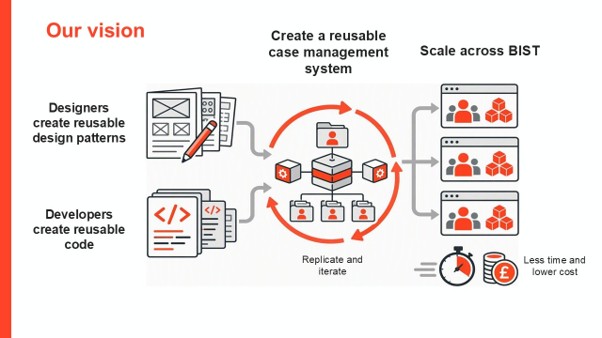
Speed was everything. We wanted to demonstrate what might be possible when we treat common case management needs as reusable capabilities at pace. Our bigger ambition is to turn our rough prototype into a longer-term reusable foundation.
The problem, and indeed the solution, is not a new one. A cross-government working group has also explored an ‘applying for something’ service pattern, which is a relevant example for our project.
There has already been plenty of excellent work done at BIST on licensing case management services and reusable design patterns. This means that we were not starting with this problem from scratch.
Designing for reuse
We started with evidence-backed patterns from an existing licensing service and reusable information flows based on existing user research insights and content design best practice. Our aim was to create a simple baseline that other services could build on.
That changed the question we were asking. Rather than, ‘what does this current service use?’, we asked, ‘which parts could another service use?’
That small shift changed how we approached the design.
For example, licence applications often ask users to add several things of the same type. These might be products, organisations, people or documents.
Instead of designing separate interactions for each one, we explored reusable patterns that allow users to add information, see a summary, then change, remove or add another item.
We also looked at how information entered earlier in an application could change what users are asked to do later.
For example, an answer could trigger a mandatory document upload. The service could then tell the user exactly what they need to provide, rather than expecting them to remember.
These are relatively simple ideas on their own. The interesting part is thinking about them as building blocks that can be combined in different ways.
What we built in 5 days
By the end of Firebreak, we had created a prototype licensing service using reusable capabilities.
It allowed external users to:
- register an organisation
- manage users
- access a dashboard
- start a new licence application
- save an application and return to it
- add products
- add different parties involved in an application
- upload documents
- add notes
- check the information provided
- submit the application
- view the submitted application
It also allowed internal users to:
- receive an application
- assign a case to themselves
- reassign a case
- view an application summary
- view full details of the application
- request further information
- request an update to the application
- add a case note
- move a case on to the next stage
Rather than just producing individual screens, we had enough of the end-to-end journey to demonstrate how reusable design and technical capabilities could work together, particularly when capturing structured data.
The prototype does not prove that we now have a reusable case management product ready for every situation. We do not.
What it does give us is something tangible. Instead of discussing reuse as an abstract ambition, we have demonstrated that reusing existing code and designs allows us to build at pace to test a prototype properly. It is then possible to customise, based on specific service needs at a fraction of the design and build time usually required.
Watch members of the Firebreak project team Cal Gott (Senior Business Analyst) and Karwai Pun (Lead Interaction Designer) discuss and give a demo of what we managed to achieve in 5 days.
If you would like a full demo of our prototype, you can contact us through the comments.
Where could this go next?
We hope to take what we built during Firebreak and apply that to real-world licensing examples.
First, we want to develop the prototype into a workable end-to-end licensing service and identify which parts form a genuinely reusable core.
The real test would then come with a second licensing journey. How quickly could we adapt what already exists? Which parts would transfer cleanly, and which would need to change? Crucially, we would measure how much time the reusable approach saves.
The project would be as much a discovery as it would be a delivery opportunity. There will be new questions and challenges as we go.
We also plan to add any patterns, components and capabilities we create as part of this work to BIST’s wider design system, so other teams can build on them too.
What we learned
Our biggest lesson was how much value already exists in previous work. That includes not only designs and code, but the research and insight that led to them. Before creating something new, it is worth asking whether another team has already solved part of the problem.
Reusable design and code are not only valuable, but vital in a landscape that demands more from digital teams, with increasingly less time and fewer resources.
That does not mean every government service should look or work in exactly the same way. It means recognising where our problems overlap and treating that overlap as an opportunity.
Firebreak was also a great opportunity to turn the regular constraint of time into a fun challenge between colleagues – to see what we can create when we’re on the clock.
Five focused days will not solve every problem. But opportunities like this can give a multidisciplinary team enough space to challenge assumptions, make an idea tangible and show what might be possible. What do you think you could achieve in 5 days?

1 comment
Comment by Dani Rodi posted on
This is so brilliant! Well done to all in the team - such great work!