Anthony Love

Last year, we launched our approach to rapidly delivering artificial intelligence solutions at the Department for Business and Trade (DBT). Since then, our teams have explored ideas from across the department. These have ranged from conducting rapid evidence assessments for emerging policy areas to giving our staff on-demand answers to their HR policy questions.
After completing more than a dozen experiments, we’ve learned a lot about the approaches that work best, the inputs needed, and some of the pitfalls. We are sharing these lessons to help other teams in government, and other large and complex organisations, to use our learning in their own AI experimentation.
These experiments put into practice innovation principles such as the importance of clear hypotheses, effective governance and giving ourselves space to fail.
It’s been an exciting journey so far. Here are some of the key lessons we’ve learned:
1. Get broad permission to experiment
Working in government, it can be difficult to experiment with new technology while also making sure that you have clear, fully documented approaches for keeping data and systems secure. If you find yourself going through complex security and assurance approaches each time you try something new, you simply won’t be able to experiment at pace.
We invested time and effort up front to make sure we had the right teams on board and were using a repeatable approach. This included setting up ‘sandbox’-style spaces for experimentation, new templates for recording how we process and protect data and tightly controlling how long we run our prototypes.
2. Build in ethics and governance
AI tools promise huge efficiency and quality-of-life benefits for our staff and customers. However, that opportunity also comes with well-documented risks of bias, unethical use of data or other unforeseen outcomes.
At DBT, we’re lucky to have teams in place that give us ready access to experts in data and AI ethics and governance. They help us to navigate tricky topics and ensure we comply with our recording and reporting obligations on AI use in government. Having this expertise in place, and involved throughout, ensures that the experiments we conduct are ethical and controlled.
3. Somebody else is probably already working on this
Very few of the use cases we’ve explored are truly unique. All have at least some aspects in common with other experiments that we or others have conducted. We’ve learned the value of asking “what makes this use case different?” and “do we already have a tool that can do most of this?”.
As a government department, we’ve been able to borrow ideas, code, technology and approaches from others, and we’d recommend others do the same. ‘DBT Assist’, our internal AI tool for all DBT staff, is a great example of this.
4. Identify a clear, measurable hypothesis
Our experiments have covered a wide range of subjects, each with a variety of problems and opportunities. Our aim has been to complete experiments rapidly, in just a few weeks each time. Some of our earlier experiments took longer than expected because we didn’t have clear measures to indicate when to stop.
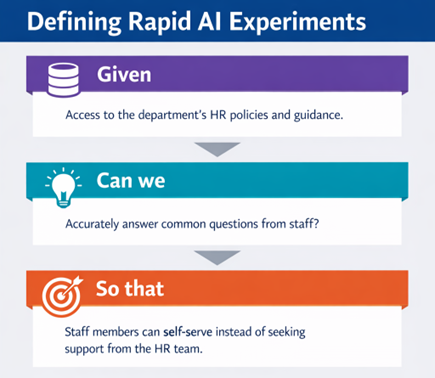
We’ve since developed an experiment template that identifies the smallest meaningful test we can perform, sets clear success measures and gives a clear threshold for continuing. We use a simple sentence format to define experiments in simple terms. ‘Given’ particular data sources or inputs, ‘can we’ produce a specific, measurable output or result, ‘so that’ a clear outcome is achieved.
For example, this is the hypothesis we identified for a recent experiment for a staff-facing HR policy search tool:
- ‘Given’: access to the department’s HR policies and guidance
- ‘Can we’: accurately answer common questions from staff
- ‘So that’: staff members can self-serve instead of seeking support from the HR team.
5. Not everything needs generative AI
With all the excitement, it’s easy to fall into the trap of thinking that AI, and particularly generative AI, is the only option. Teams we spoke to were sometimes more excited about having ‘an AI tool’ than about solving any particular problem. Often, however, the complexity and costs (financial and environmental) of an AI-based approach just don’t stack up.
While we have still used generative AI for many of our experiments, we learned quickly to identify those that could be better delivered through more traditional data science, digital and technology approaches. We did this by identifying which other teams we could work with, and by seeking input from relevant subject matter experts across our digital, data and technology teams.
6. Use a mix of tools and approaches
At DBT, many of our digital services are custom-built and open-source. For AI experiments, though, we’ve recognised that a custom-built approach isn’t always the best way to test new and emerging capabilities. Over the past few years, we’ve seen new tools – both commercial and open-source – appearing almost daily, and we want to explore a wide range.
It’s also important to consider the potential route to production for AI tools and services, and the users, systems and data you need to connect with. Over the past few months, we’ve used a mix of direct development on AWS Bedrock, Microsoft Copilot agents and building new custom ‘tools’ on DBT Assist, our internal AI tool.
7. Keep content current and realistic
Early on, a lot of our experiments struggled. This was because we couldn’t easily distinguish between outdated content or gaps in source material and AI model hallucinations or omissions.
We’ve found that it is essential to use realistic, up-to-date content and data during testing. For us, this has meant working out how we can securely use real source data in our experiments. We’ve also spent time tidying up and improving source content whenever we can. This allows us to ask realistic questions and get realistic answers to put in front of subject matter experts for review.
8. Be careful with your prototypes
For many of our experiments, we’ve been keen to develop simple user interfaces. These prototypes can be essential for giving the development team and subject matter experts the ability to test and rate the performance of AI outputs.
However, sometimes these prototypes have raised expectations about how quickly we can build the real thing. We’ve learned to restrict access to our prototypes just to those who need them for testing, and to spend time explaining their limitations to stakeholders.
9. Always keep an eye on your credits
It can be easy to overspend using generative AI tools. For one of our experiments, we used an AI search tool to find and summarise relevant news articles about specific UK companies. Each individual search only cost a few pence but, when one of our users ran a bulk search, they inadvertently triggered thousands of searches! Fortunately, we had set a strict spend limit on the tool, so the user got an error message instead of a hefty bill.
Nonetheless, we learned the importance of closely monitoring spend, setting up email alerts and making active use of spend and rate limits available in commercial tools.
10. Technology alone cannot do it all
So, you’ve got an amazing idea for an AI tool that can make life easier for hundreds of people across your organisation, and a successful experiment to prove that it works. However, this isn’t enough. We’ve learned that, even with all the excitement about AI, making changes happen in large and complex organisations still requires traditional business and process transformation.
For us, this means we focus on getting clear senior sponsorship before we start any AI experiment. We also ask subject matter experts and key decision-makers to commit their time throughout. This means that we can understand the problem, test the solution and make a realistic plan for implementation. AI can help get people’s attention, but it needs to be followed by meaningful time commitment.
Looking ahead
We’ve taken these lessons on board and recently made some changes to how our AI teams work together. We’ll continue to run rapid experiments, while also developing and running AI tools in production. We’re also investing in how we enable other teams at the Department for Business and Trade to implement AI in their own services.
We’d love to hear from teams that have been experimenting with or building AI tools for themselves – in government or otherwise. Have you learned any of the same things? Are there other solutions or approaches that you think we should try? Any important lessons that you think we’ve missed? Get in touch with our AI team on ai.lab@businessandtrade.gov.uk